The Lagging Left
Waterloo's newest solution for pedestrian prioritization.

About a month ago, on my usual walk to the University of Waterloo, something about the traffic signal phasing caught me off guard. The next day, I saw it again, and instantly realized what it was- the lagging left. These are somewhat rare in Ontario, and after a month of using intersections with them, I would like to give my take on it. I’ll explain what they are, how they have been holding up in the real world, and modifications I would like to see long term.
The Case for the Lagging Left
To provide some context, the area to the east of UWaterloo is full of dense student housing. Busses are frequent, at least for a city the size of Waterloo, and the ION light rail passing through the area is a transit backbone for the region. Unsurprisingly, there is high pedestrian activity.
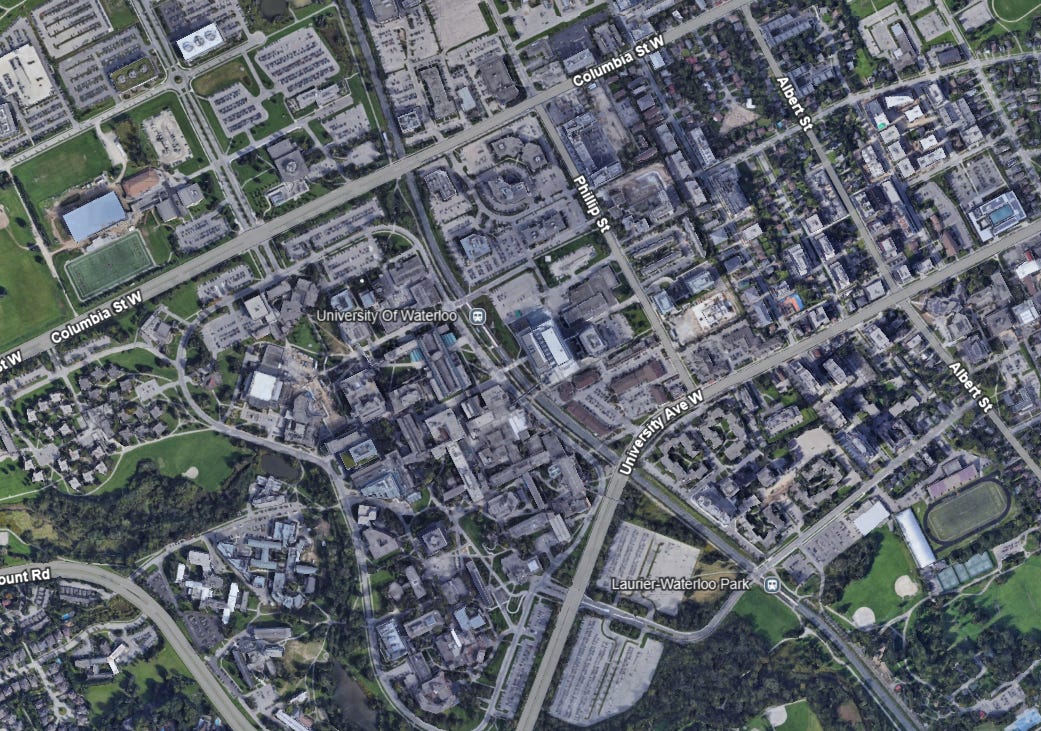
The standard signal phasing for an intersection with advanced left turns should be familiar to most people:
Left turn arrow appears for a few seconds giving left turning drivers priority.
Solid green- all movements are allowed, and left turners must yield to oncoming traffic (and pedestrians if they care enough).
Yellow —> Red
For a few years now, cities like Toronto are installing Leading Pedestrian Intervals (LPIs) at many of their intersections. They give pedestrians a few-second head start before the light turns green for drivers. LPIs have been studied to drastically improve pedestrian safety, because they increase the visibility of a pedestrian in the intersection, especially for left turning drivers.
Now, the seemingly obvious problem is that you cannot have both an advance left and an LPI. It makes no sense to put the LPI phase after the advance left, as you are putting pedestrians in direct risk of drivers who try to beat the light. If you put the LPI first, then you can no longer have the left turn phase, as there will now be pedestrians crossing.
In a place with high pedestrian activity, it should be desirable to make their experience as safe as possible (I’m talking to you, Panama City, maybe for another article). For many intersections, an LPI is simply not feasible because of the advance left.
So, what is a solution to having both? Put the left turn phase after the pedestrians have finished crossing, a lagging left. The phasing goes as follows:
LPI phase
Solid green (all movements allowed)
Yellow —> Red
Left turn arrow
A Month Later- Observations and Recommendations
Pedestrians and Drivers
I am unable to find official data from the Region of Waterloo on where or how in many intersections lagging lefts were implemented, but I am aware of a few. An example of an intersection that has a lagging left is Columbia St. W and Phillip St., just outside campus.
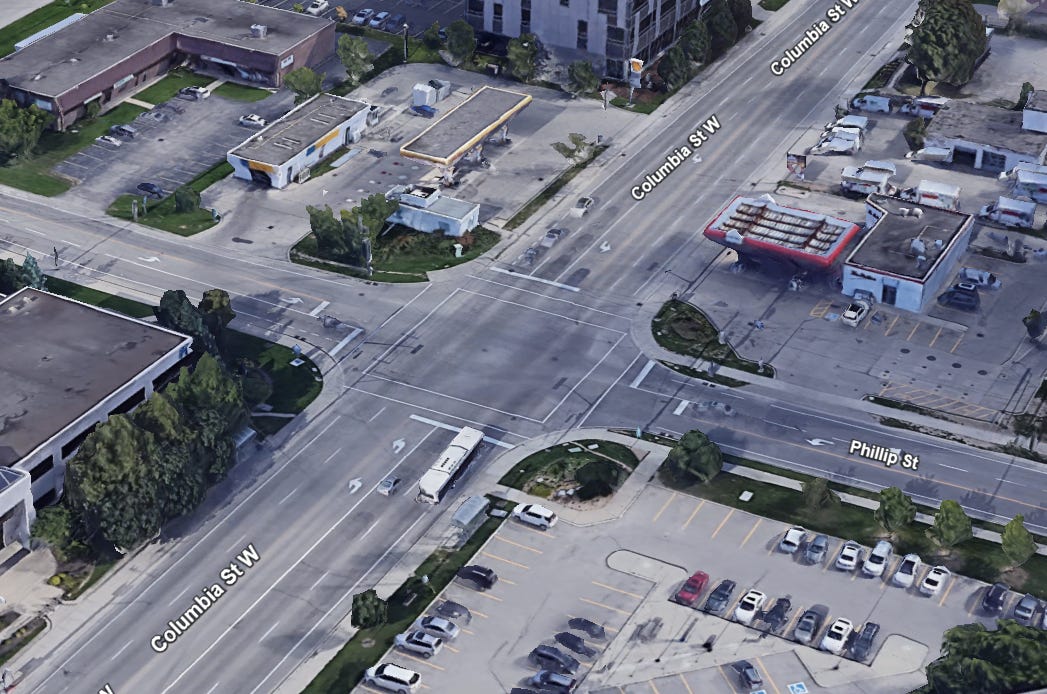
The first thing I noticed was that the arrangement was unfamiliar to many users. Pedestrians absent-mindedly waiting for the green barely noticed the LPI phase, although this improved in a matter of days and is hardly an issue now.
Drivers sometimes do not expect the lagging left. I witness the same scenario almost every day; the car waiting to turn left stops at the red, and just sits there even as the left turn arrow comes on. Frustrated drivers waiting behind tap their horns to no avail, and everyone ends up missing the left turn phase. I do understand that most people subconsciously stop looking at the light as soon as it turns red, and would thereby miss the left turn phase.
Overall, I would not consider the fact that some drivers are outright ignoring it a reason to go back— the vast majority of drivers do just fine, and the rest will get it someday, especially if it becomes more popular. I suspect the Region of Waterloo might be treating the current implementation as a form of A/B testing.
Sometimes the Lagging Left Lags
In periods of low traffic, sometimes the lagging left is activated unnecessarily. All the cars turning left might have been able to make the turn during the normal green phase, however the traffic signal controller still thinks that cars are waiting to turn left, and activates the lagging left phase. This only really happens if the cars make the turn right at the end of the green phase, or into the yellow/red phase.
A possible explanation for this is the limits of using inductive loop detection in the asphalt as opposed to camera or radar. It is difficult to show that a car is moving with induction loops. A camera system might be able to tell that a car is in the process of clearing the intersection, and clear the lagging left phase. Some intersections already have cameras for traffic studies, so I presume Waterloo Region will become aware of this phenomenon at some point.
Implementation of the LPI
A drawback in the current implantation of LPI is that it holds back the straight through movement which does not conflict with pedestrians at all. (This is especially frustrating if the LPI activates without any pedestrians around).
Counterproductively, LPIs can even delay transit vehicles. There is no reason not to allow cars going straight at the same time as pedestrians. In fact, we can turn to examples within Canada to see how it is done. Quebec has fantastic implementation of this.
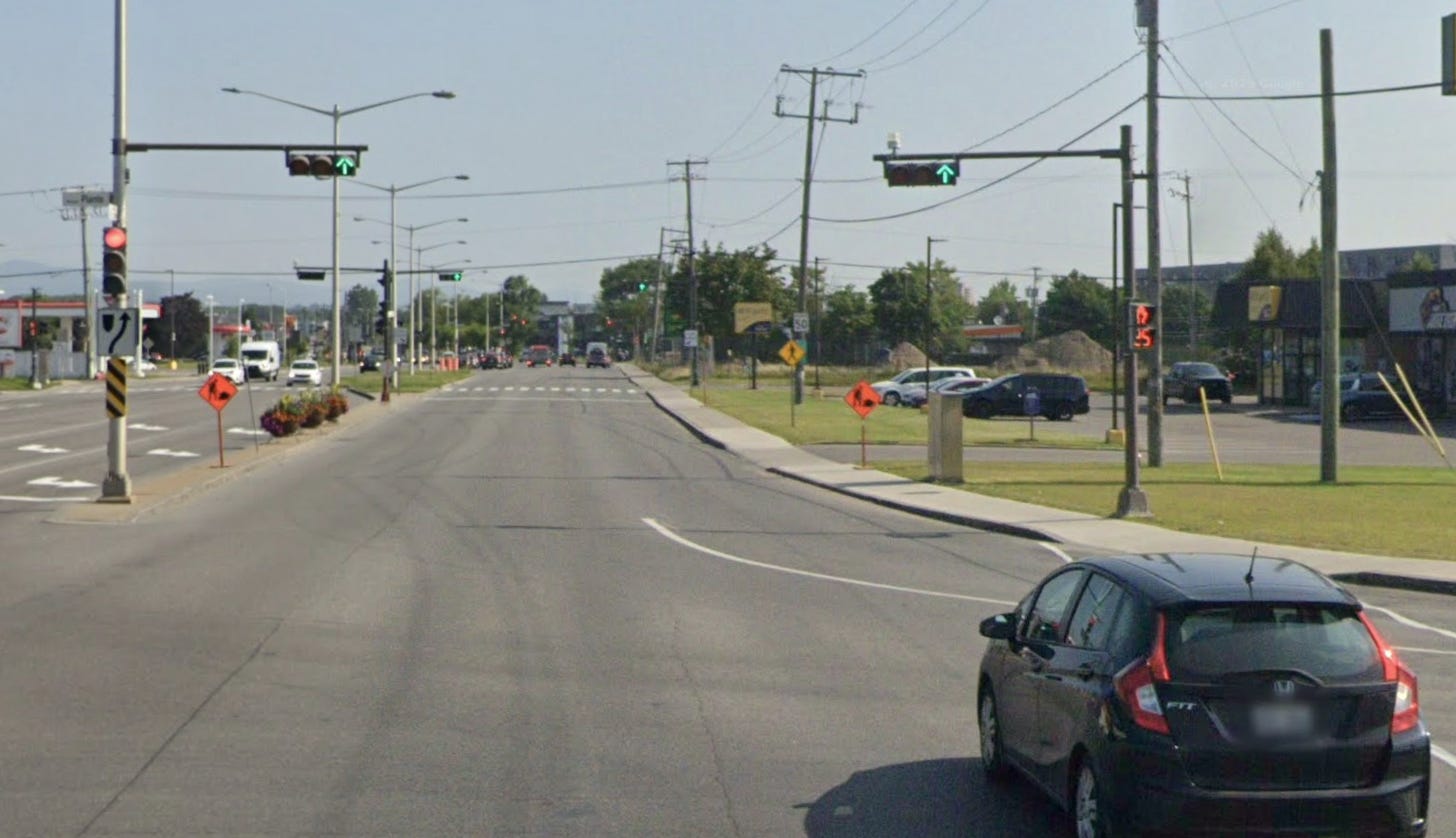
We see in this example the inclusion of the straight-only arrow at the same time as the LPI. This allows vehicles to continue straight at the same time as pedestrians, and only allowing conflicting turns a few seconds after. Implementing this would be the piece de resistance of a lagging left intersection, and would help optimize traffic flow without compromising safety.
Conclusion
Waterloo should be credited with trying to implement new solutions, and adding the lagging left shows the will to improve at a time when many cities are stagnant. The lagging left appears to be a good design that incorporates an LPI, improving pedestrian safety with no new infrastructure.
There are some minor snags during off-peak times with unnecessary phasing, and hopefully that will be ironed out in the future. I would also like to see Waterloo be even a little more innovative with the lagging left and incorporate the Quebec LPI model. Overall, I look forward to what Waterloo has in store.
Thank you for reading my first post on Substack. This is still a learning experience, so let me know what you think.