
State Highway Shtick
The quest to fix the left turn.

Across the highways of the USA, various Departments of Transportation have implemented unique intersection designs in a bid to fix the left turn. The left turn is the most dangerous part of any intersection, and it is the hardest to optimize traffic flow around. For many years there has been a desire to get around this problem, without turning every intersection into an full fledged interchange.
Some states swear by tried-and-true designs, and build them wherever they get the chance. Hence, we get layouts that are uniquely popular in their respective states.
The New Jersey Jughandle
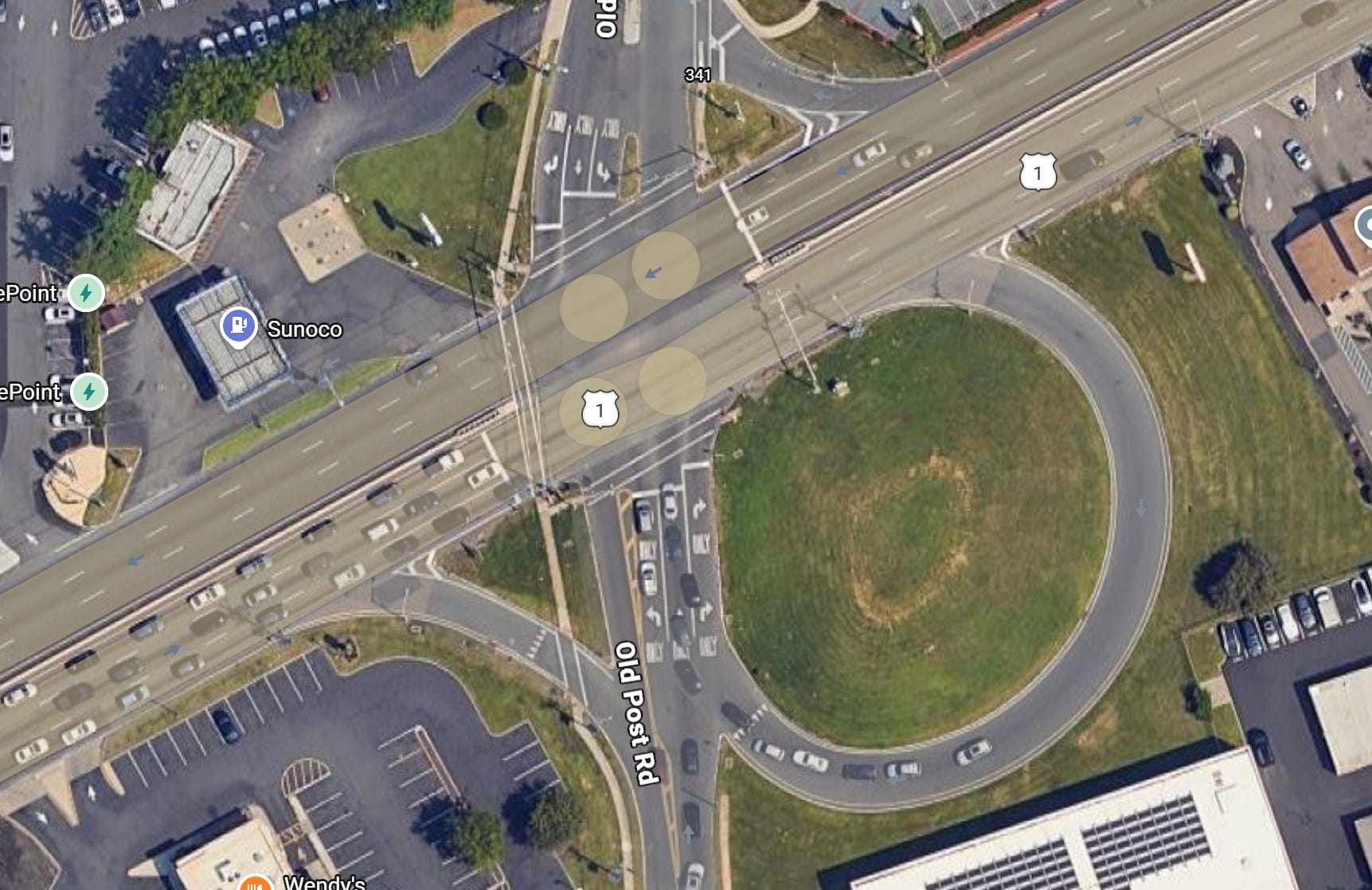
Many roads in New Jersey have intersections where all turns are made from the right lane. This is accomplished through ramps before and/or after the intersection. In the case of the looping ramp (as seen in the above image), drivers wanting to make a left turn first pass through the intersection and then loop back to complete the turn. This configuration is known as a jughandle, and New Jersey is full of them.
By removing left turns at the intersection, signal timing can be simplified, and it is safer to make a left turn because you are not turning across opposing traffic (typically the most dangerous movement in any intersection).
Sometimes, the jughandle does not use loops, but only uses ramps to take turning traffic away from the main intersection. This is not as good as removing left turns entirely, but it still has its benefits. An example is shown below, where traffic wanting to turn from US 1 onto Old Post Road must use the ramp and make the turn from there.
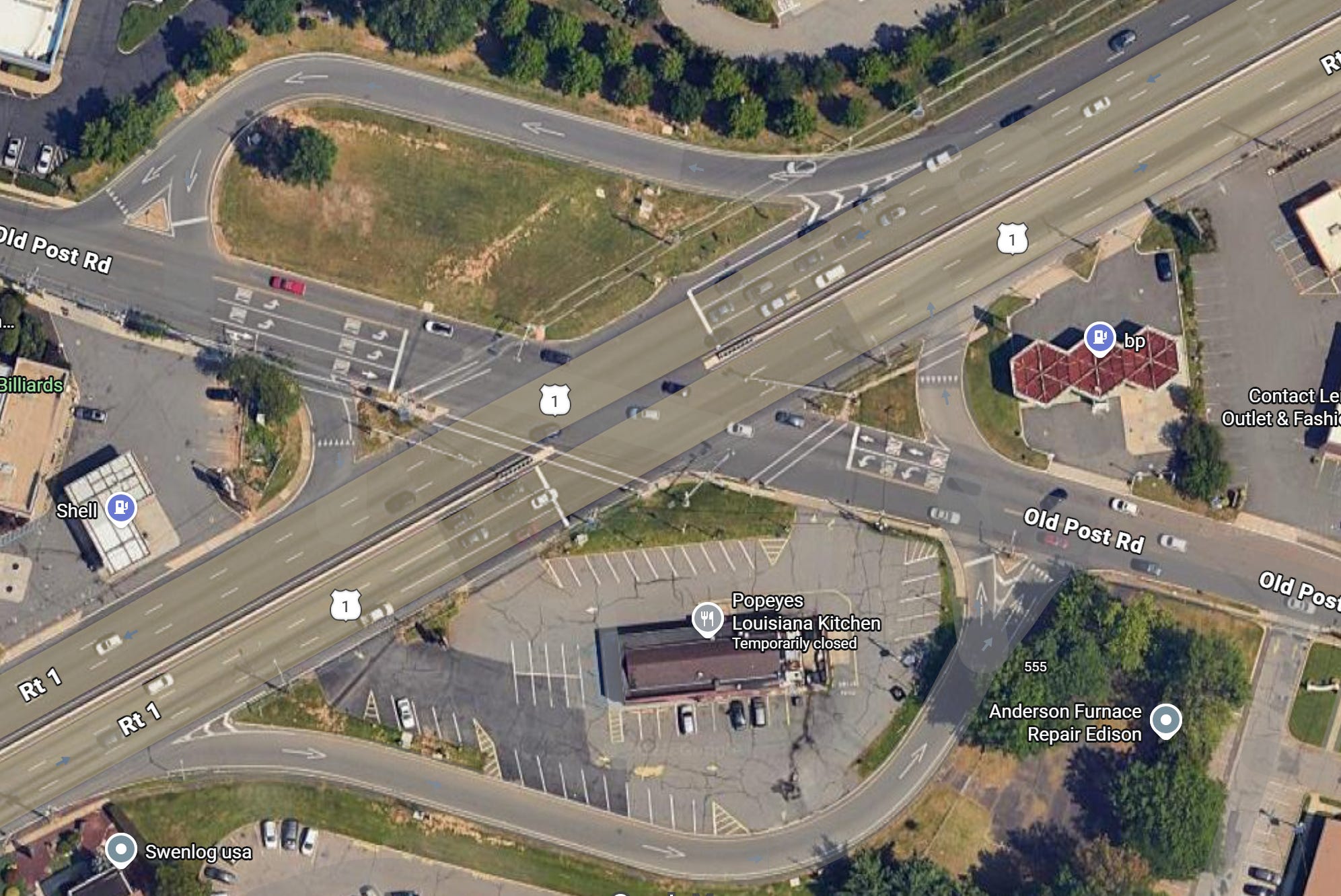
There are a few disadvantages with the jughandle. As with most of the ‘solutions’ in this article, it will create a hostile pedestrian environment (although I don’t think New Jersey’s built form caters to that regardless). When the crossing street has high traffic volumes, traffic might struggle to complete the turn and back up onto the ramp, causing gridlock. Lastly, it could be land intensive, although in some cases like the one above, fine dining establishments can fit in these awkward locations.
The Texas Turnaround
Texas has a ‘frontage road’1 obsession. Virtually every urban freeway and even many rural ones have parallel roadways on either side that allow access to adjacent property.
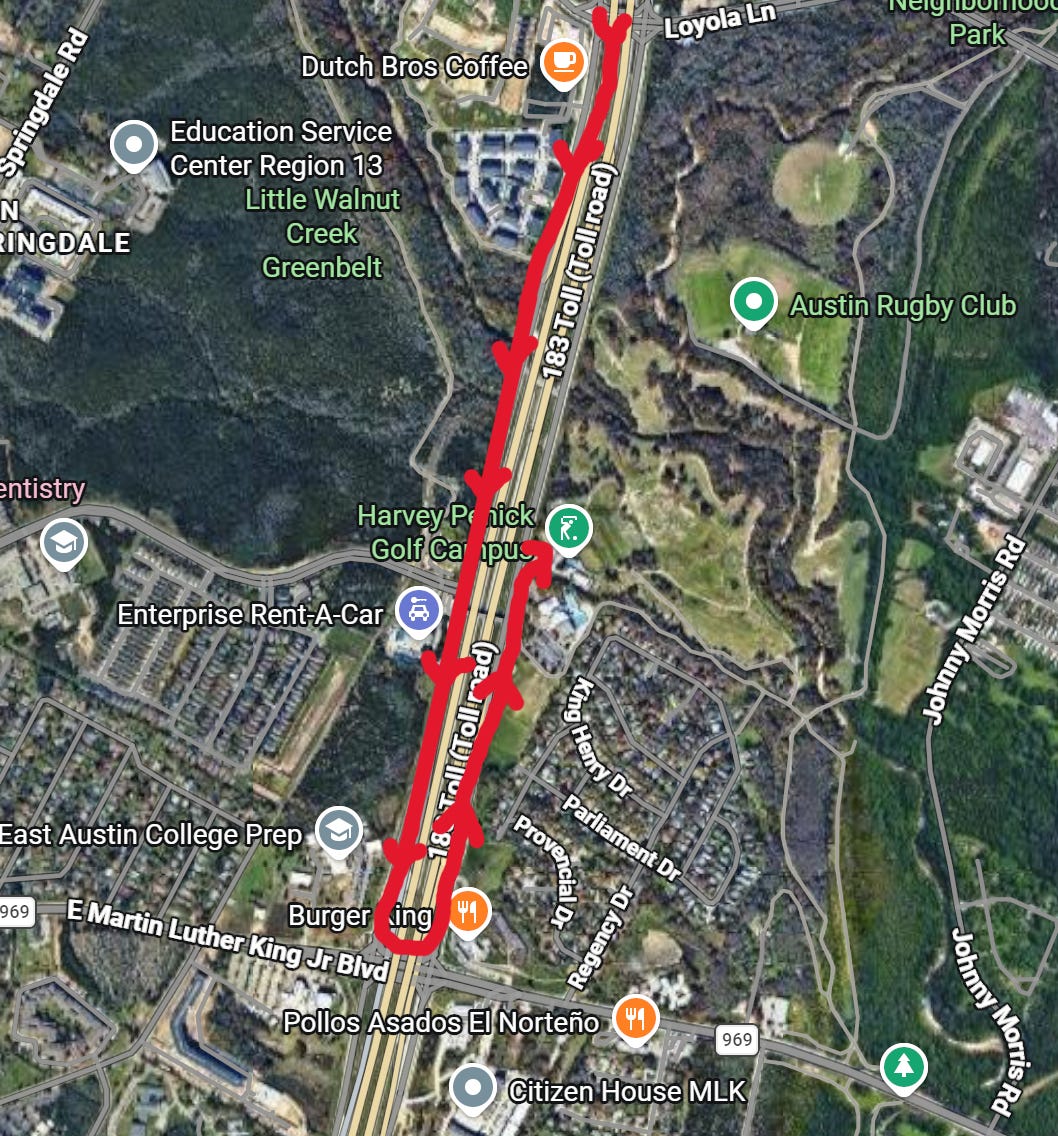
Let’s say that you are driving down SH 183 in Austin, and decide that you want to go to a golf course on the other side of the freeway. You first exit onto the southbound frontage road, and then at the next intersection, have to make your way to the northbound frontage road to backtrack to your destination (see the image below).
This maneuver should in theory require two left turns- one to get off of the southbound frontage road, and one to get on the northbound frontage road. This can create lots of traffic in those two intersections that is really only trying to make a simple u-turn.
The Texas turnaround shuttles people between opposing frontage roads without having them make left turns, bypassing the two intersections entirely:
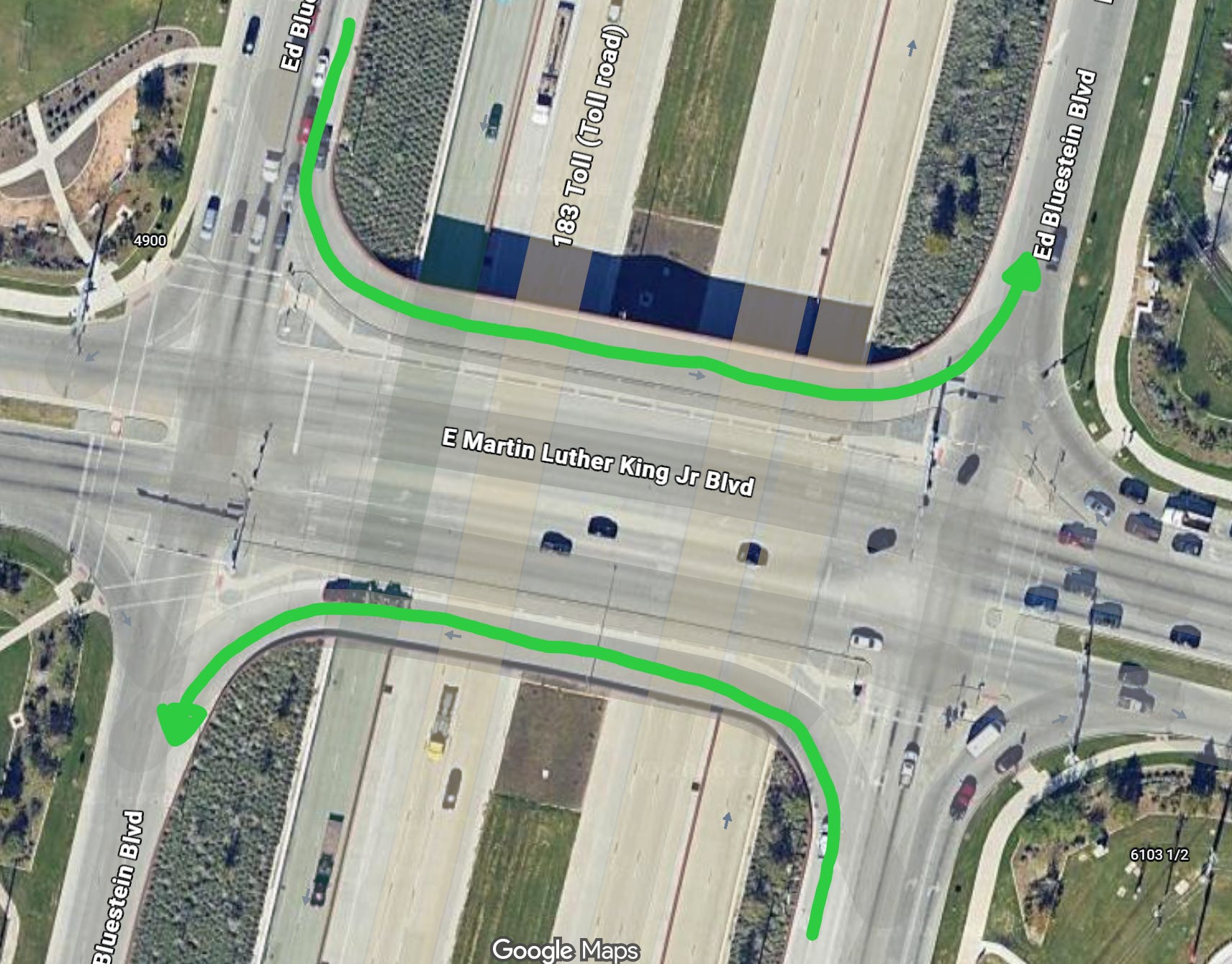
As shown, traffic that simply wants to make a u-turn has a dedicated ramp just before the intersection, and they no longer have to make two left turns. This frees up intersection capacity for those actually turning left at the intersection.
The Michigan Left
Similar to the designs previously discussed, the Michigan left also removes left turns from the intersection itself. The Michigan left accomplishes this by first requiring a right turn, and then a u-turn for those turning onto the main road. For example:
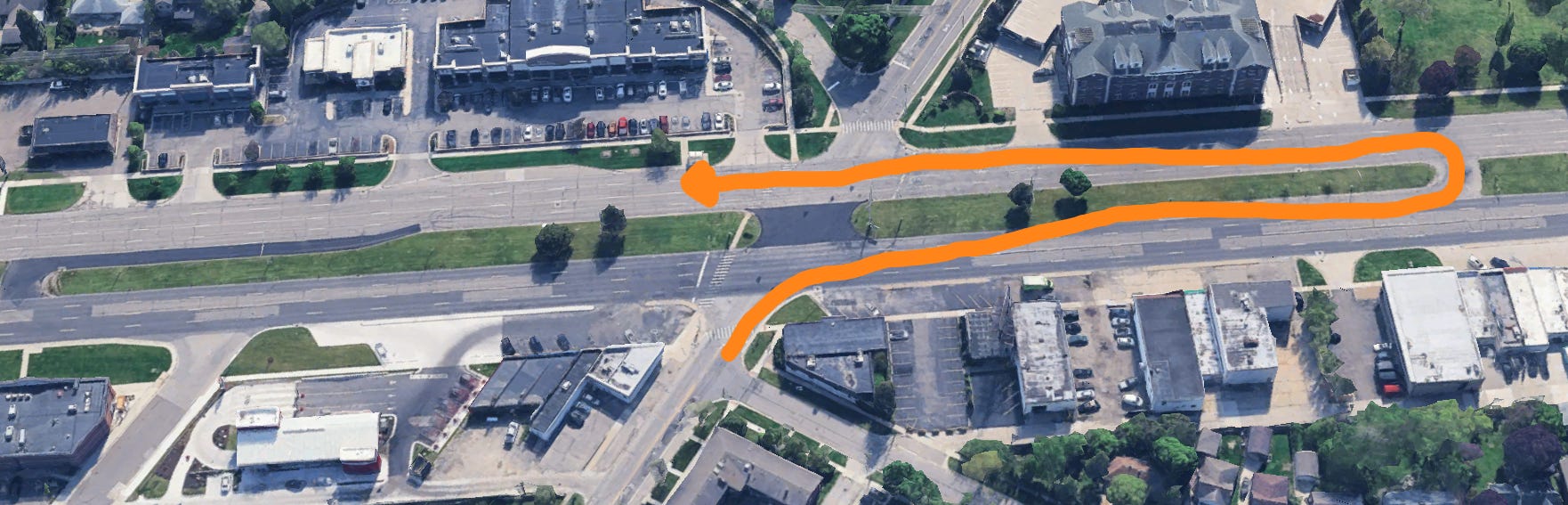
Similarly, drivers on the main road wanting to turn left onto the side street continue past the intersection, make the u-turn, and then turn right. The u-turns are accommodated with dedicated ramps at either end of the intersection.
The Michigan left can drastically improve signal timing, because there are no left turn phases at the intersection itself. In optimal situations with synchronized lights, a road with Michigan lefts can move freeway amounts of traffic.
One caveat is that for the Michigan left to work well, large medians are often required to provide a sufficient turning radius for the u-turn. Nevertheless, the design has worked not only in Michigan but in many other countries as well.
There Are Many More
The three intersections mentioned here happen to be fairly ubiquitous in their respective states, however that does not mean other states have not tried more designs.
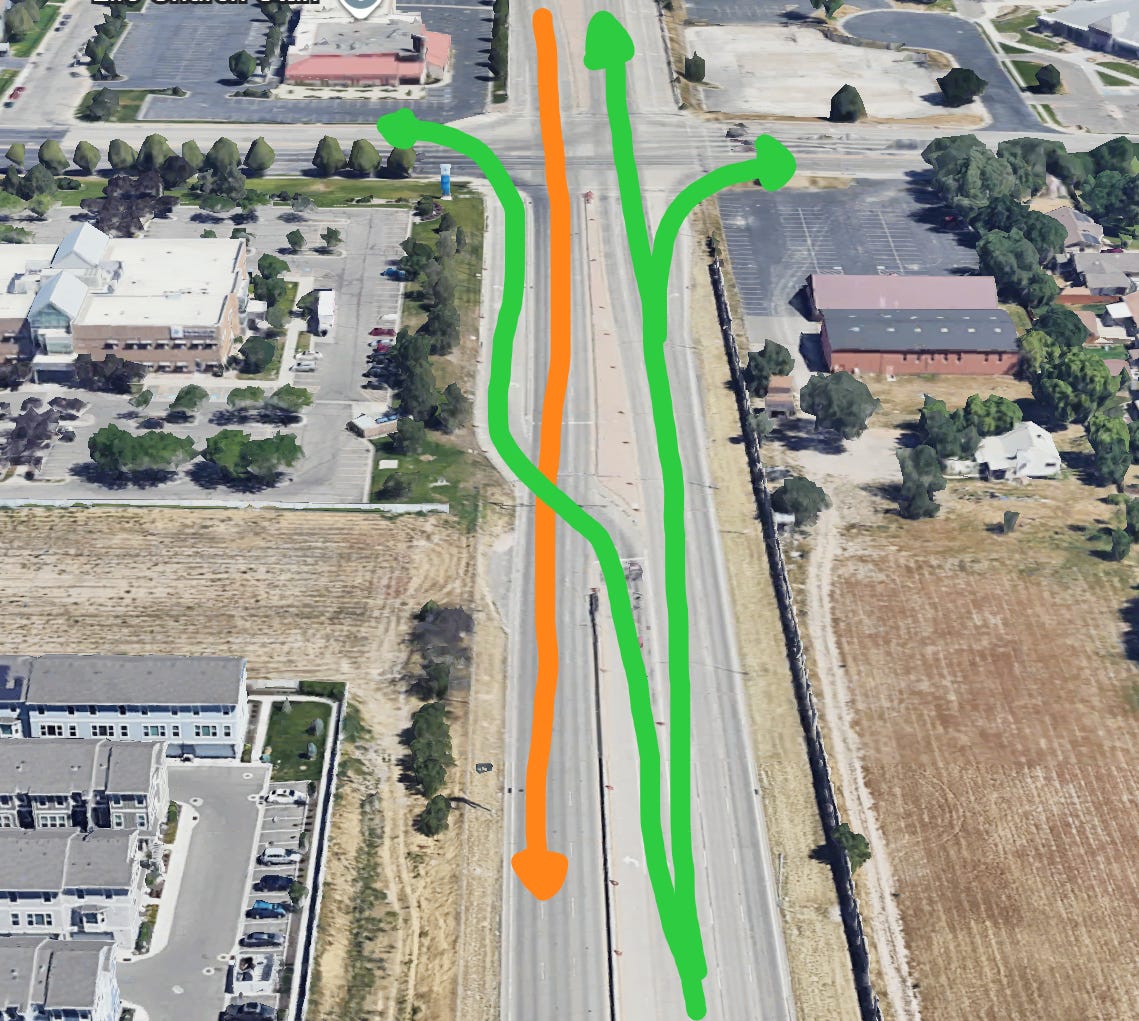
Utah, for example, is known to build Continuous Flow Intersections (CFIs). I’ll save the bulk of the technical explanation for Wikipedia, but in general, a CFI intersection shifts the left turns to the oncoming side of the intersection via a signalized crossover, so that they can occur at the same time as through traffic.
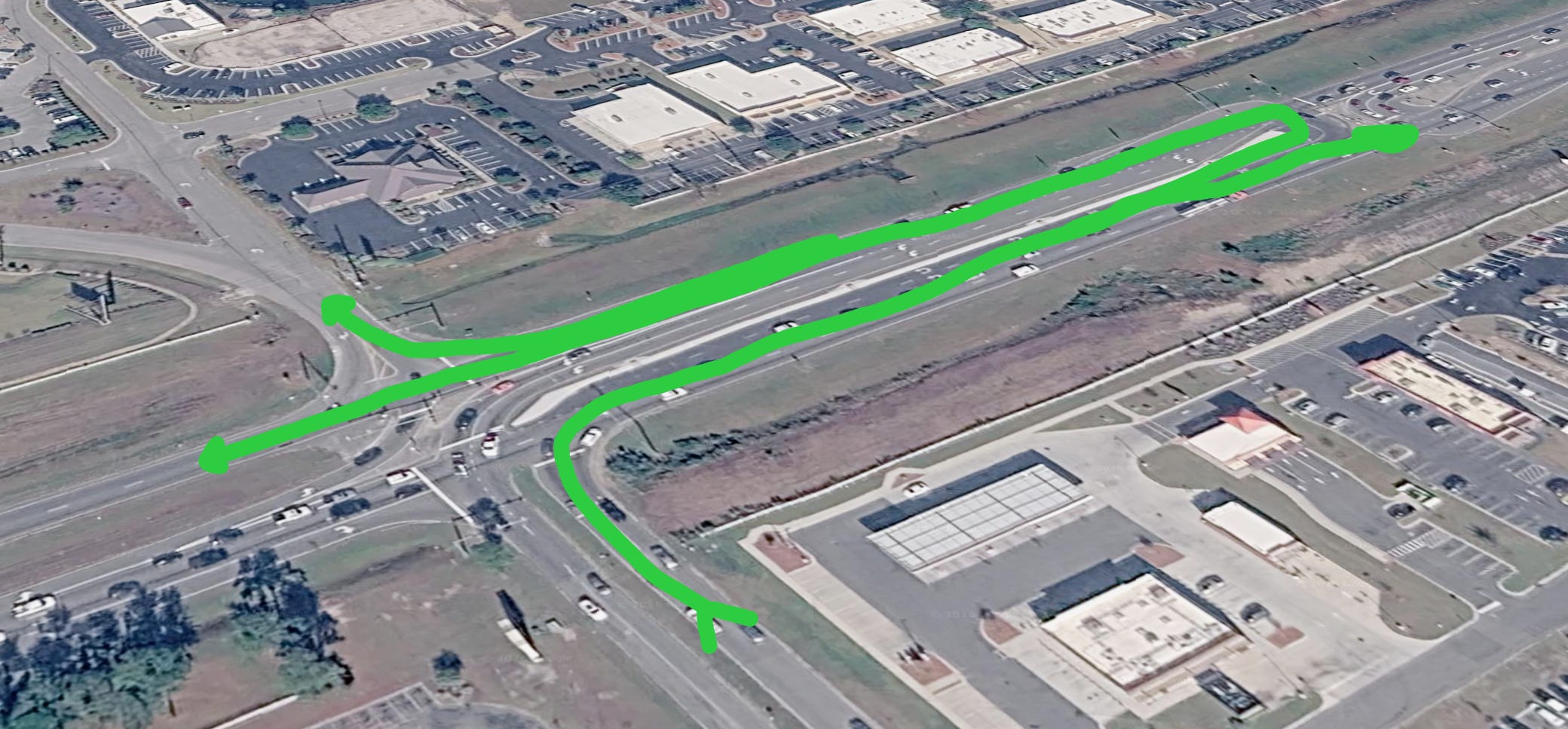
Additionally, there is the superstreet, which is up and coming in North Carolina but has also been constructed in several other states. A superstreet is a very similar concept to the Michigan left, but this time, traffic on the side street may not continue straight across the intersection. Rather, all approaching traffic must turn right.
Another example is Indiana, which loves their roundabouts, and has been constructing them on nearly every new interchange that they have built. Carmel, Indiana, is known to be the roundabout capital of the USA- there are hardly any traffic lights in Carmel. Roundabouts are an excellent solution to so many of the problems our roads face, with a proven safety record. It would be great if they were built in more places.
Are some of these overengineered? Yes. Simpler, less complex solutions are often best. Ideally, grade separation will always be superior in locations where it is warranted and the space exists. And, in an ideal world, we would make built environments more conducive to other modes of transportation. Given that the built, car dominated environment of North America is here to stay for the time being, it is worth at least trying to make roads safer.
The way roads are designed plays a crucial role in our transportation system. Unique problems, such as frontage roads in Texas, are confronted with unique solutions. Michigan’s wide medians are perfect for the Michigan left, which requires space to make a u-turn. There is no one right answer, but it is fascinating to see how each place arrives at their own.
Known as feeder roads in other parts of Texas. In Ontario, they are known as service roads.